
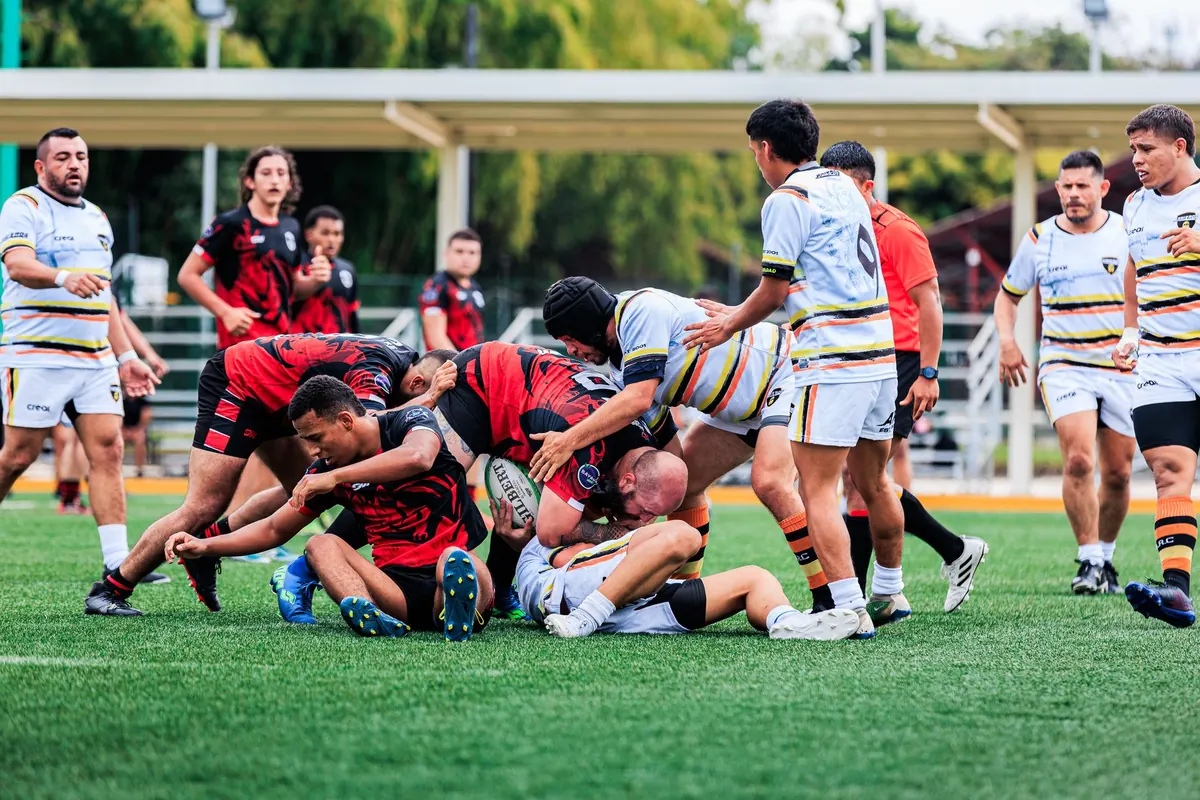
You do not need to understand rugby union to enjoy the first ten minutes of a match. The noise, the collisions, the sudden gaps — it all works without a rulebook. Then someone near you shouts "the eight picked from the base" and the whole thing turns into a puzzle. This guide solves that puzzle. Fifteen positions, plain English, from the front row to the fullback.
Read it once before kick-off and you will recognise most of what happens. Read it twice and you will start predicting it.
Fifteen Numbers, Two Families
Rugby numbers are not random. They are a map. Shirts 1 to 8 belong to the forwards, the bigger players who contest scrums, lineouts, rucks and mauls. Shirts 9 to 15 belong to the backs, who generally handle the ball in space and do the running and passing.
One warning: in some club competitions players keep a squad number all season, so the shirt does not always match the job. In international rugby and most traditional competitions, the 1-to-15 numbering still tells you exactly where a player stands.
The Forwards: The Heavy Machinery
Front row (1, 2, 3)
The props wear 1 and 3, the hooker wears 2. Props are the anchors of the scrum: they bind tight, hold their body position, and absorb enormous pressure so the scrum does not wheel or collapse. The loosehead prop (1) has his head outside the opposing pack, which usually makes life slightly easier than the tighthead prop (3), who is squeezed between two opponents and does the heaviest pushing.
The hooker throws the ball into lineouts, which is a skill in its own right: a flat, fast, accurate throw to a jumper four or five metres away, often under pressure. All three front-rowers lift jumpers and carry the ball into contact when the game gets tight and muddy.
Second row (4, 5)
The locks are usually the tallest players on the pitch. They jump in the lineout, push in the scrum, and drive mauls forward. Watch the two lifters either side of a jumper in a lineout — one of them is often a prop, and the timing between thrower, jumper and lifters is rehearsed all week.
Back row (6, 7, 8)
Flankers and the number 8. The blindside flanker (6) tends to be bigger and works the narrow side of the pitch, carrying hard and hitting rucks. The openside flanker (7) is the scavenger: first to the breakdown, hunting turnovers, slowing down the opposition's ball. Commentators call that "jackaling" — getting over the tackled player and ripping or holding the ball legally.
The Number 8: The Position Without a Twin
The number 8 deserves his own section because he sits between two worlds. In the scrum he is bound at the back, with the ball at his feet. He can leave it for the scrum-half, pick it up and run himself, or pass. That single decision often sets the tone of an attack.
In open play he is a ball carrier who runs into traffic rather than around it. Modern eights are also lineout options and, increasingly, the player who makes the last-ditch tackle on a wing. Many captains wear 8 because the role requires reading the whole game, not just one corner of it.
The Backs: Space, Speed and Decisions
Half-backs (9, 10)
The scrum-half (9) is the link between forwards and backs. He passes from every ruck, feeds the scrum, box-kicks when his team needs territory, and occasionally darts through a gap himself. A quick, accurate pass from 9 gives the whole attack an extra half-second.
The fly-half (10) is the decision-maker. He stands at first receiver, takes the ball from 9, and chooses between passing to the centres, kicking for territory, kicking for goal, or running. When a team looks calm under pressure, it usually means the 10 is having a good day.
Midfield (12, 13)
The inside centre (12) is often a second playmaker and a physical ball carrier — the player who straightens the attack when the defence drifts wide. The outside centre (13) tends to be faster and more elusive, looking for the half-gap between defenders and passing to the wings when it opens up.
Wings and fullback (11, 14, 15)
Wings finish. Their job is to be in the right place at the right time, chase kicks, and defend against the opposing wing one-on-one. The fullback (15) is the last line of defence and often the best kicker in the back three: he catches high balls, returns kicks, and joins the attack at pace. A good fullback saves tries you did not realise were coming.
Quick Reference: Who Wears What
- 1 Loosehead prop — scrum anchor, occasional ball carrier.
- 2 Hooker — lineout thrower, scrum middle man.
- 3 Tighthead prop — the heaviest scrum workload.
- 4 and 5 Locks — lineout jumpers, maul drivers.
- 6 Blindside flanker — narrow side, physical carries.
- 7 Openside flanker — breakdown specialist, turnover hunter.
- 8 Number 8 — ball at the scrum base, link to the backs.
- 9 Scrum-half — tempo, passing, kicking from the ruck.
- 10 Fly-half — chief decision-maker and goal kicker.
- 12 Inside centre — second playmaker, straightens the attack.
- 13 Outside centre — breaks the line, releases the wings.
- 11 and 14 Wings — finishing and kick chasing.
- 15 Fullback — last defender, counter-attacker.
How to Follow One Phase
Pick a single ruck and watch it properly. First find the 9 — everything starts with him. Then find the 10 and see where he stands: flat and close to the defence means he wants to run or pass; deep means he is likely to kick. Then watch the openside flanker, who is usually the first defender over the ball.
Once you can track those three players, the shape of the whole team appears. Do it for ten phases in a row and you will notice things that experienced fans are shouting about a second before they happen.
Watching Your First Match
Do not try to learn all fifteen positions in one sitting. Follow one player for twenty minutes — a flanker or a fly-half is a good start, because both are involved constantly. Learn the names of the front row. Then check the numbers when the teams run out, and see if you can guess the position before the graphic comes up.
The more you watch, the more the apparent chaos turns into shape. That is the moment rugby stops being confusing and starts being addictive.