

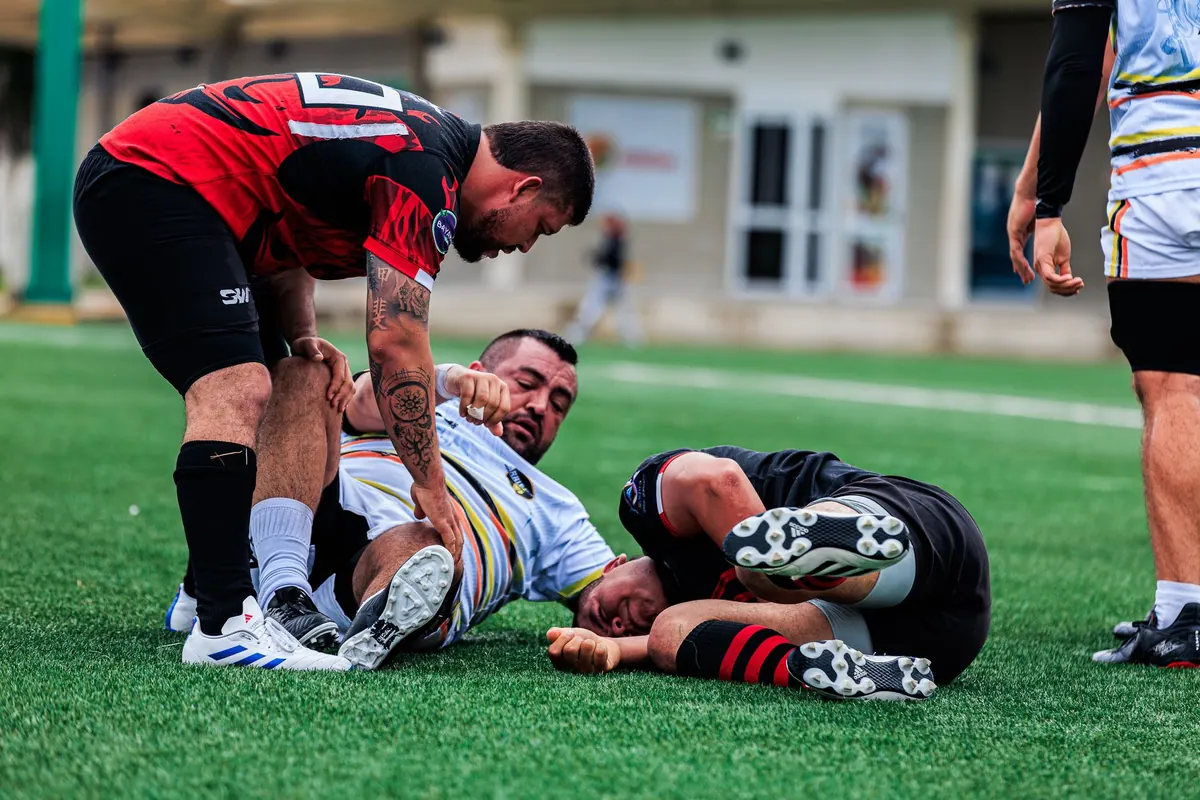
The off-season is the only part of the year when you get to decide what your body becomes. In-season you're surviving: managing knocks, chasing selection, training around a fixture list that doesn't care how your hamstrings feel. Then the season ends, and a lot of players do nothing for six weeks before panicking in August.
A better off-season has three parts that hold each other up: strength work that makes you harder to break, speed work that keeps your top gear intact, and recovery habits that let both stick. Here's how to build it.
Map the Off-Season Before You Lift Anything
Start with a calendar, not a barbell. Count the weeks between your last match and the first day of pre-season, then break them into blocks of four: three weeks building, one easier week to absorb the work. Twelve weeks gives you three blocks. Five weeks gives you one, and you should be honest about what fits.
Write down what actually hurt this season. A shoulder that clicked overhead, a calf that tightened in the second half, a back that stiffened after long drives. Anything that has lingered for more than a couple of weeks deserves an assessment from a physiotherapist before you load it. Training around a problem is fine. Training through it usually isn't.
Set two goals per area, and make them behaviours rather than wishes. "Squat my bodyweight for five reps" and "run ten 30-metre sprints without my hamstring tightening" are useful. "Get faster" isn't.
One more thing: tell someone your plan. A training partner, a coach, the physio you see anyway. Players who write a plan and keep it to themselves tend to drift by week three. Players who have to report back usually don't.
Strength: Build the Base First
Off-season strength is about general qualities: more muscle, stiffer tendons, a trunk that holds position when someone runs into you. It is not a machine circuit performed at pace until you're sick. Save that for pre-season.
You're also not chasing a one-rep max for its own sake. The goal is to come back in better shape than you left — more robust in the collisions, more capable in the positions your game actually puts you in. If you play front row, that means bracing under load. If you play wing, that means producing force at speed. Same base, different emphasis.
The movements worth your time
Almost everything you need comes from six patterns: a squat, a hinge, a push, a pull, a carry, and a single-leg movement. Cover those with honest loads and you're most of the way there.
- Squat: back squat, front squat, or goblet squat if you're rebuilding from a back niggle.
- Hinge: trap bar deadlift, Romanian deadlift, or a heavy hip thrust.
- Push: bench press, overhead press, or a weighted push-up.
- Pull: chin-ups, pull-ups, and any row variation you can load.
- Carry: farmer's carry or suitcase carry for trunk and grip.
- Single-leg: split squats, lunges, or step-ups — these catch the imbalances the season left behind.
Sets, reps, and how hard to go
Three to four sets of five to eight reps on the main lifts is a reliable default. Leave one or two reps in the tank on most sets, and add a little weight or a rep each week. Two full-body sessions a week will build a lot of player. Three is better if you're young, fresh, and sleeping well.
Add the smaller stuff where it matters: hamstring curls and Nordic progressions for the players who tweak hamstrings every year, calf raises for anyone who has rolled an ankle, and some direct neck and shoulder work if you're in the front row. A few minutes at the end of a session is enough.
Progress in the off-season is boring by design. The same six movements, a little heavier, a little better, for twelve weeks.
Speed: Keep the Top Gear You Spent All Season Building
Speed is the quality that fades fastest when you stop using it. It's also the hardest to get back. If you spend the entire off-season in the gym and on the bike, you'll come back strong and slow — and slow is what gets you beaten to the corner.
The rule for speed work is simple: quality, not fatigue. Sprints are short, rest is long, and you stop when your times drop off. If you're gasping at the end of a rep, you're doing conditioning, not speed.
Two sessions a week is plenty. Keep them away from your heaviest lower-body gym day, ideally the day before or two days after.
A simple speed session
- Warm-up: ten minutes of jogging, skips, and build-ups.
- Six to eight accelerations over 10 metres, full recovery between each.
- Six to eight sprints over 20 to 30 metres at full effort, walking back between reps.
- Optional: three to four hill sprints over 15 to 20 metres if you want the extra hamstring load.
- Cool down and stretch.
If you only have one speed session a week, make it this one. If you have a second, use it for tempo runs — relaxed efforts over 60 to 100 metres with short rest — which build the aerobic base without frying you.
Recovery: The Part That Makes the Other Two Stick
You can't train your way past bad sleep, poor food, and constant stress. Recovery isn't a reward for training; it's the other half of it.
Sleep and fuel
Aim for seven to nine hours. If you're getting six, everything else in this article is working at half strength. Protein at every meal, roughly 1.6 to 2.2 grams per kilogram of bodyweight per day, carbohydrates to fuel the sprint work, and enough water that your urine isn't dark.
You don't need a cabinet of supplements. Protein powder, creatine, and a decent diet cover almost everything a rugby player needs.
The boring habits that outperform the fancy ones
- Eight hours of sleep beats any recovery gadget.
- A ten-minute walk after meals beats a foam roller you use once a week.
- Consistent weekly progression beats a brutal session followed by three days of soreness.
- One full rest day a week beats active recovery you don't actually need.
- Less alcohol, honestly. It's the single biggest lever most players ignore.
A Sample Off-Season Week
Here's what a mid-block week can look like for a player with a twelve-week off-season. Scale it to your number of available days.
- Monday: Full-body strength, heavier lower body.
- Tuesday: Speed session, short sprints.
- Wednesday: Rest or light mobility.
- Thursday: Full-body strength, heavier upper body.
- Friday: Tempo runs or a second speed session.
- Saturday: Optional third strength session or a long walk.
- Sunday: Full rest.
Every fourth week, cut the volume by about a third. You'll feel like you're wasting time. You aren't — this is the week the work becomes adaptation.
Mistakes That Cost You the Season
- Doing nothing for six weeks, then trying to cram twelve weeks of work into four.
- Training every session to failure and living sore.
- Skipping speed work because the gym is enough.
- Ignoring an injury that's been niggling since March.
- Returning to pre-season heavier, slower, and stiffer than you finished the season.
The off-season doesn't need to be complicated. It needs to be consistent, honest, and long enough to matter. Build the base, keep the speed, and let your body actually recover — then walk into pre-season as the player your team didn't expect.